ESS-DIVE

Deep Insight for Earth Science Data

CONTACT
  • DATA
    • SEARCH DATA
    • SUBMIT DATA
    • ACCESS DATA PORTALS
    • DATA PRESERVATION
    • DATA USE AND CITATION
    • TERMS OF USE
  • ABOUT
    • WHAT WE DO
    • TEAM
    • PARTNERSHIPS
    • PARTNER PROJECTS
    • FEATURES AND SERVICES
    • OPPORTUNITIES
  • GET STARTED
    • DATA SUBMISSION GUIDELINES
    • ESS-DIVE DOCUMENTATION
    • PROJECT CHECKLIST
    • PROPOSAL GUIDELINES
    • DATA REPORTING FORMATS
    • FAQs
  • LEARN MORE
    • NEWSROOM
    • WEBINAR LIBRARY
    • TRAINING EVENTS
    • TRAINING VIDEOS
    • PUBLICATIONS
    • ACRONYMS/GLOSSARY
  • STATUS
  • DATA
    • SEARCH DATA
    • SUBMIT DATA
    • ACCESS DATA PORTALS
    • DATA PRESERVATION
    • DATA USE AND CITATION
    • TERMS OF USE
  • ABOUT
    • WHAT WE DO
    • TEAM
    • PARTNERSHIPS
    • PARTNER PROJECTS
    • FEATURES AND SERVICES
    • OPPORTUNITIES
  • GET STARTED
    • DATA SUBMISSION GUIDELINES
    • ESS-DIVE DOCUMENTATION
    • PROJECT CHECKLIST
    • PROPOSAL GUIDELINES
    • DATA REPORTING FORMATS
    • FAQs
  • LEARN MORE
    • NEWSROOM
    • WEBINAR LIBRARY
    • TRAINING EVENTS
    • TRAINING VIDEOS
    • PUBLICATIONS
    • ACRONYMS/GLOSSARY
  • STATUS

February Webinar on ESS-DIVE and Urban Integrated Field Laboratories Data

February 1, 2023 by Dylan O'Ryan

ESS-DIVE Webinar

Monday, February 27 | 10:00-11:00 PT / 13:00-14:00 ET

View Webinar Recording / Link to Webinar Slides

ESS-DIVE is excited to welcome Urban Integrated Field Laboratory (Urban IFL) projects to DOE ESS. We invite all who are part of an Urban IFL project and broader ESS researchers to an introductory webinar about the ESS-DIVE data repository for Earth and environmental system science data, and associated resources for project data management. We will also have a discussion on data management needs for Urban IFL projects.  

We will cover the following topics:

  • Overview of ESS-DIVE and our data;
  • ESS-DIVE project data management features; 
  • Resources to organize and curate high-quality datasets; and
  • Discussion on Urban IFL data management needs.

Please encourage anyone from your project who may be interested to attend. 

The webinar will be presented by Joan Damerow and Emily Robles.

Joan Damerow, Lead Scientist

Joan is an environmental scientist with a background in geoscience sampling, freshwater ecology, and biodiversity informatics. She runs activities for ESS-DIVE, including ESS-DIVE webinars, our annual data workshop, and is active in relevant conferences and data working groups (e.g. ESIP, RDA, AGU). Joan is interested in interdisciplinary data management and tracking, and works with DOE ESS data contributors to identify, develop, and implement practical data standards in ESS-DIVE that support FAIR principles.
Emily Robles, Data Management Research Associate

Emily is a research associate and a member of ESS-DIVE’s team. Her work with ESS-DIVE focuses on utilizing research and feedback to implement a comprehensive data package review workflow for data publication. She has experience with data package organization and quality management as a member of the NGEE Tropics data team and received her BS in Environmental Science from the University of California, Berkeley.

Filed Under: Homepage Features, news

January Webinar on ESS-DIVE’s Reporting Format for UAS Data and Metadata

December 22, 2022 by Dylan O'Ryan

ESS-DIVE Webinar

Monday, January 30 | 10:00-11:00 PT / 13:00-14:00 ET

View Webinar Video / Link to Webinar Slides

Are you interested in publishing or using data from small Unoccupied Aerials Systems (UAS)? With rapid development of platform and sensor technologies, the use of UASs, also known as UAVs or drones, in Earth sciences is becoming increasingly common. This webinar will review the new UAS data and metadata reporting format that is in development, and provide you an opportunity to give feedback.

We will cover the following topics:

  • Benefits of using reporting formats,
  • Types of data that this format will cover and associated challenges,
  • Metadata variables to describe flight details and equipment, 
  • Categorizing data by processing level, and
  • Discussion and feedback. 

You can review the draft UAS data and metadata reporting format before the webinar, although this is not required to attend.  This webinar will be presented by Kim Ely and Shawn Serbin from Brookhaven National Laboratory (BNL).

Please encourage anyone from your project who may be interested to attend.

Filed Under: Homepage Features, news

ESS-DIVE at AGU 2022

December 2, 2022 by Dylan O'Ryan

The ESS-DIVE Team is looking forward to participating in the 2022 AGU Fall Meeting. Below are several abstracts that we will be presenting at the meeting!

BASIN-3D: Data Synthesis Software for Earth Science Researchers (H12P-0874)

Presenter: Danielle Christianson
Presentation Type: Poster
Session Date and Time: Monday, 12 December 2022; 9:00 AM – 12:30 PM CST / 7:00 AM – 10:30 AM PST
Session Number and Title: H12P: Hydroinformatics and Data Science: Pathways to Support Reproducible Watershed Modeling II Poster
Session URL: https://agu.confex.com/agu/fm22/webprogrampreliminary/Paper1153073.html

Abstract

Danielle S Christianson, Valerie C Hendrix, Catherine Wong, Charuleka Varadharajan, and Deb Agarwal, Lawrence Berkeley National Laboratory, Berkeley, CA, United States


Developed (meta)data reporting formats to enable data reuse in environmental repositories (IN41A-06)

Presenter: Charuleka Varadharajan
Presentation Type: Online Poster Discussion
Session Date and Time: Thursday, 15 December 2022; 8:40 AM – 8:48 AM CST / 6:40 AM – 6:48 AM PST
Session Number and Title: IN41A: Adopting Trustworthy Data Repository Stewardship to Enable Reuse of Data Across Disciplines I Online Poster Discussion
Session URL: https://agu.confex.com/agu/fm22/webprogrampreliminary/Paper1163669.html

Abstract

Charuleka Varadharajan1, Robert Crystal-Ornelas1, Dylan O’Ryan2, Bond-Lamberty Benjamin3, Kathleen Beilsmith4, Kristin Boye5, Madison Burrus1, Shreyas Cholia1, Danielle S Christianson1, Michael Cameron Crow6, Joan E Damerow1, Kim S Ely7, Amy E Goldman8, Susan L Heinz9, Valerie C Hendrix1, Zarine Kakalia1, Kayla Cerise Mathes10, Fianna O’Brien1, Stephanie C Pennington11,12, Emily Robles1, Alistair Rogers7, Maegen Simmonds1,13, Terri Velliquette6, Pamela Weisenhorn14, Jessica Nicole Welch6, Karen Whitenack1 and Deb Agarwal1, (1)Lawrence Berkeley National Laboratory, Berkeley, CA, United States, (2)Lawrence Berkeley National Lab, Berkeley, CA, United States, (3)Pacific Northwest National Laboratory, College Park, MD, United States, (4)Argonne National Laboratory, Chicago, United States, (5)SLAC National Acceleratory Laboratory, Stanford Synchrotron Radiation Lightsource, Menlo Park, CA, United States, (6)Oak Ridge National Laboratory, Oak Ridge, TN, United States, (7)Brookhaven National Laboratory, Environmental Sciences Department, Upton, NY, United States, (8)Pacific Northwest National Laboratory, Biological Sciences, Richland, WA, United States, (9)Oak Ridge National Laboratory, Oak Ridge, United States, (10)Virginia Commonwealth University, Integrative Life Sciences, Richmond, VA, United States, (11)Pacific Northwest National Laboratory, College Park, United States, (12)Joint Global Change Research Institute, College Park, United States, (13)Pivot Bio, Berkeley, United States, (14)Argonne National Laboratory, Argonne, IL, United States


A FAIR Guided Approach to Improving Metadata Quality in a Large Scale Data Repository (IN41A-03)

Presenter: Emily Robles
Presentation Type: Online Poster Discussion
Session Date and Time: Thursday, 15 December 2022; 8:16 AM – 8:24 AM CST / 6:16 AM – 6:24 AM PST
Session Number and Title: IN41A: Adopting Trustworthy Data Repository Stewardship to Enable Reuse of Data Across Disciplines I Online Poster Discussion
Session Link: https://agu.confex.com/agu/fm22/webprogrampreliminary/Paper1199893.html

Abstract

Emily Robles1, Charuleka Varadharajan1, Madison Burrus1, Shreyas Cholia1, Robert Crystal-Ornelas1, Joan E Damerow1, Hesham Elbashandy1, Valerie C Hendrix1, Christopher S. Jones2, Matthew B. Jones3, Zarine Kakalia1, Mario Melara1, Fianna O’Brien1, Peter Slaughter2, Karen Whitenack1 and Deb Agarwal1, (1) Lawrence Berkeley National Laboratory, Berkeley, CA, United States, (2) National Center for Ecological Analysis and Synthesis, Santa Barbara, CA, United States, (3) National Center for Ecological Analysis and Synthesis, DataONE, Santa Barbara, CA, United States


Enabling proper Citation of Individual Objects Across Large Collections of Datasets (IN42B-0338)

Presenter: Deb Agarwal
Presentation Type: Poster
Session Date and Time: Thursday, 15 December 2022; 9:00 AM – 12:30 PM CST / 7:00 AM – 10:30 AM PST
Session Number and Title: IN42B: Adopting Trustworthy Data Repository Stewardship to Enable Reuse of Data Across Disciplines II Poster
Session Link: https://agu.confex.com/agu/fm22/webprogrampreliminary/Paper1188622.html

Abstract

Deb Agarwal1, Martina Stockhause2, Lesley A Wyborn3, Justin James Henry Buck4, James Ayliffe4 and Shelley Stall5, (1) Lawrence Berkeley National Laboratory, Berkeley, CA, United States, (2) German Computing Centre (DKRZ), Hamburg, Germany, (3) Australian National University, Canberra, ACT, Australia, (4) National Oceanography Center, BODC, Liverpool, United Kingdom, (5) American Geophysical Union, Data Leadership, Washington, DC, United States


Sample tracking and synthesis needs for exploring ecosystem response to environmental disturbance (IN55A-03)

Presenter: Joan Damerow
Presentation Type: Oral
Session Date and Time: Friday, 16 December 2022; 3:06 PM – 3:14 PM CST / 1:06 PM – 1:14 PM PST
Session Number and Title: IN55A: Global Efforts to Make Samples, Specimens, and Sampling Features (As Well Digital Information About Them) Comply with the FAIR and CARE Principles III Oral
Session Link: https://agu.confex.com/agu/fm22/webprogrampreliminary/Paper1121127.html

Abstract

Joan E Damerow1, Elisha M Wood-Charlson1, Charuleka Varadharajan1, Mikayla Borton2, Eoin Brodie3, Richard S. Canon4, Shreyas Cholia1, Paramvir Dehal5, Zachary Crockett6, Emiley Eloe-Fadrosh7, Ricardo J Eloy Alves8, Kjiersten Fagnan7, Amy E Goldman9, David Hays10, Valerie C Hendrix1, Lee Ann McCue11, Nancy Shiao-Lynn Merino12, Marka Miller4, Chris Mungall13, Supratim Mukherjee10, T.B.K. Reddy10, Patrick Sorensen3, Montana L Smith14, James Stegen15, Pajau Vangay4, Pamela Weisenhorn16, Steven Wilson17 and Deb Agarwal1, (1) Lawrence Berkeley National Laboratory, Berkeley, CA, United States, (2) Colorado State University, Soil and Crop Sciences, Fort Collins, United States, (3) Lawrence Berkeley National Laboratory, Earth and Environmental Sciences Area, Berkeley, CA, United States, (4) Lawrence Berkeley National Laboratory, Berkeley, United States, (5) Lawrence Berkeley National Lab, Berkeley, United States, (6) Oak Ridge National Laboratory, Oak Ridge, United States, (7) Joint Genome Institute, Walnut Creek, CA, United States, (8) Lawrence Berkeley National Laboratory, CESD, Berkeley, CA, United States, (9) Pacific Northwest National Laboratory, Biological Sciences, Richland, WA, United States, (10) Joint Genome Institute, Berkeley, United States, (11) Pacific Northwest National Lab, Richland, United States, (12) Lawrence Livermore National Laboratory, Livermore, United States, (13) Lawrence Berkeley National Laboratory, Environmental Genomics and Systems Biology, Berkeley, United States, (14) Pacific Northwest National Laboratory, Environmental Molecular Sciences Laboratory, Richland, United States, (15) Pacific Northwest National Laboratory, Richland, United States, (16) Argonne National Laboratory, Argonne, IL, United States, (17)Joint Genome Institute, Berkeley, CA, United States

Filed Under: Homepage Features, news

Strengthening FAIRer Earth and Environmental Systems Science Data with DOE ESS-led Reporting Formats

November 15, 2022 by lncore

Earth and environmental systems science (ESS) research is evidence-based and relies on the analysis and modeling of heterogeneous and multi-scale datasets. The volume of ESS data has risen sharply in recent years, with more data gathered by the minute. This may come as positive news—however, much of this data remains unarchived, difficult to access, and even unusable. Among other challenges, many scientists lack the resources and ability to archive and share their data using consistent methods. Earth science has moved toward adopting Findable, Accessible, Interoperable, and Reusable (FAIR) data principles to solve this problem.

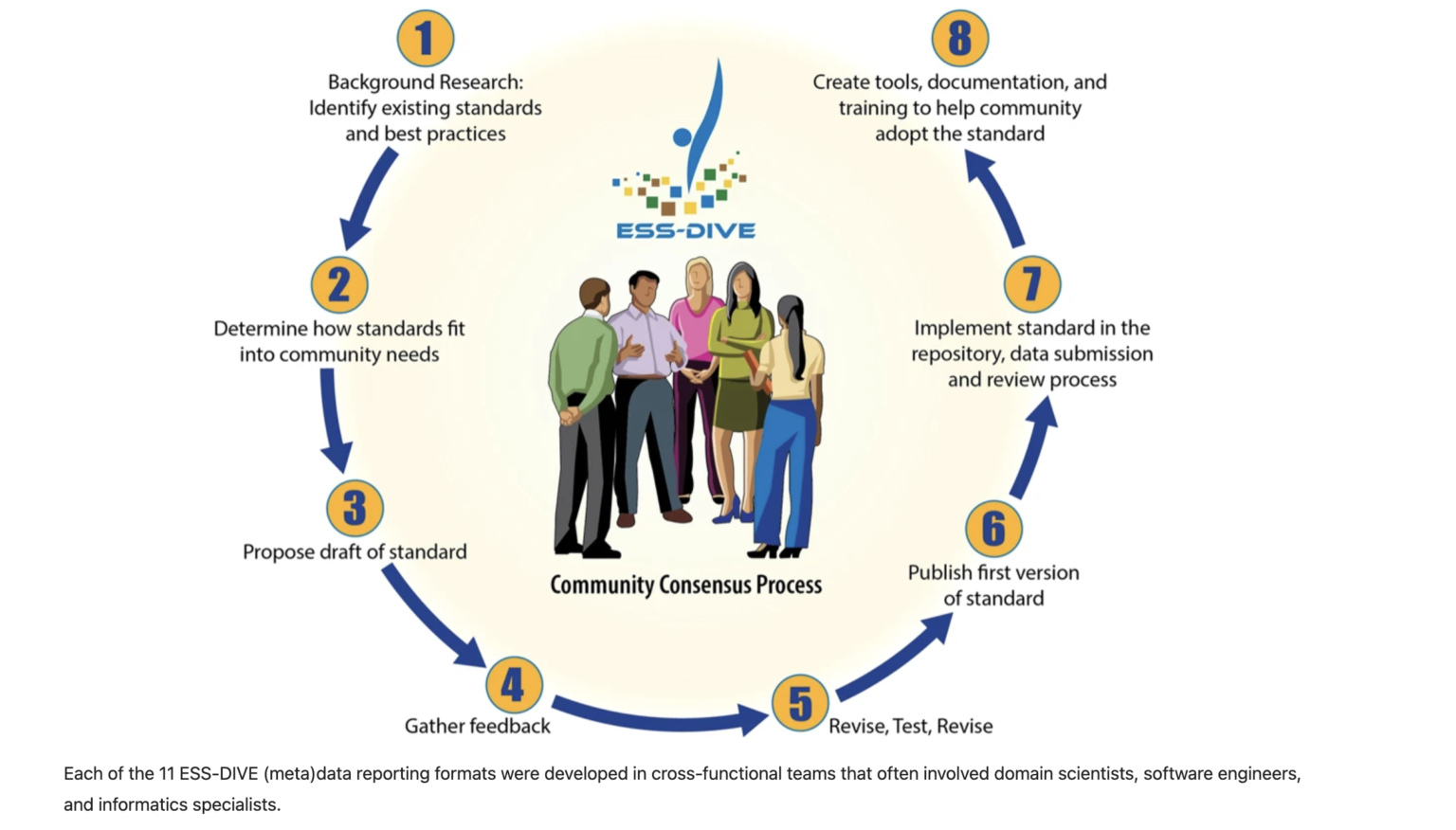
A new paper authored by the Earth and Environmental Systems Science for a Virtual Ecosystem (ESS-DIVE) team seeks to address these issues and presents 11 novel reporting formats for organizing and describing various types of Earth science data in public databases. Published in Scientific Data, the ready-to-use formats are available in the ESS-DIVE data repository, as well as on ESS-DIVE’s Workspace GitHub. ESS-DIVE provides a centralized location to store and share open and standardized datasets to enhance scientific collaboration and data reuse.

“This publication is the result of a dedicated and collaborative effort across six U.S. DOE national labs, and a testament to the value of computational and Earth science researchers partnering for positive impact,” said Charuleka Varadharajan, a Scientist in the Earth and Environmental Sciences Area at Berkeley Lab, and lead of its Earth AI and Data program. “These reporting formats come at a time when they are urgently needed to enable our ability to extract insights from complex environmental systems data.”

A DOE ESS effort for a FAIRer future 

Supported by the U.S. Department of Energy (DOE) Office of Science Biological and Environmental Program, ESS-DIVE brought together teams of scientists across the DOE National Lab Network with the aim of helping researchers within DOE ESS provide more standardized and well-described data. Together, they identified and created instructions and templates for formatting heterogeneous environmental data types. The DOE ESS-centered process involved reviewing over 100 existing data standards, conventions, or other reporting formats—and receiving input from 247 scientists representing 100+ institutions.

“A highlight of the reporting format development process was monthly meetings that convened many of the scientists leading the reporting format development process,” says Robert Crystal-Ornelas. “During these working sessions, we could harmonize on key terminology relevant across reporting formats, and share successes and challenges with the broader reporting format group.”

Covering data types commonly used by DOE, some of the reporting formats are intended to standardize commonly used descriptions about the data, referred to as “metadata,” such as information about the dataset locations and samples from where the data were generated. Others provide instructions for formatting and describing data files such as the comma-separated value (CSV) format or guidelines for organizing model data.  The other reporting formats are more domain-specific and focused on data types of importance to ESS research such as leaf-level gas exchange, soil respiration, water and sediment chemistry, hydrologic monitoring, and microbial amplicon abundances.

Crystal-Ornelas also stated that the scale of the outreach and input received on the reporting formats underscores how big a need there was for this type of standardization within Earth and environmental sciences. He’s excited to see the formats used by researchers around the world, including inputs from across and outside of the National Lab Network.

Shreyas Cholia, Group Leader for the Integrated Data Systems Group (Scientific Data Division) at Berkeley Lab, said: “ESS-DIVE is designed as a scalable framework that allows data providers to contribute standardized, structured, and high-quality data. The reporting formats are a vitally important contribution that supports long-term data stewardship. reproducible research, and data standardization across DOE ESS.”

This collaborative approach paves the way for future innovation around FAIRer data and may serve as a model for other organizations that would like to develop (meta)data reporting formats for other types of data.

Filed Under: Homepage Features, news

Register for the 2022 ESS-DIVE Annual Data Workshop to Advance Environmental System Science through Collaborative Data Management

November 1, 2022 by lncore

High-quality, openly available data are needed to solve global environmental challenges. However, important environmental systems science (ESS) data often remains difficult to access, unarchived, or even unusable. To help improve access to and use of ESS data, the U.S. Department of Energy (DOE) supported the establishment of the Earth and Environmental Systems Science Data Infrastructure for a Virtual Ecosystem (ESS-DIVE).

In addition to storing and managing critical data, ESS-DIVE provides educational and hands-on opportunities. ESS-DIVE will host a free Annual Data Workshop on November 9-10, 2022 from 9 am – 2 pm PT / 12 pm – 5 pm ET to support data management across collaborative ESS teams. The hands-on virtual workshop will help attendees efficiently manage their project data as a team and will also support teams as they describe, organize, and publish data.

“From tips and tricks that make data management easier to data publication best practices, the workshop is a great opportunity to receive first-hand support using ESS-DIVE,” says Joan Damerow, Lead Scientist. “This workshop is a unique opportunity for the ESS-DIVE team to work directly with DOE ESS researchers through hands-on tutorials. The meeting aims to create an environment to share information about ESS data, data management practices, and challenges.”

Like ESS-DIVE’s 2021 Annual Data Workshop, the event is designed to introduce newcomers to ESS-DIVE and help those familiar with the initiative to sharpen their data practices. This year’s event will focus on new collaborative features and resources offered by ESS-DIVE that make working together on data management and publishing datasets easier. The workshop will cover topics such as how to submit, download, and manage data on ESS-DIVE. Participants can learn from one another and work together on data management solutions. Workshop participants can also learn about ESS-DIVE features, data, and vision.

Here’s what attendees of last year’s workshop had to say:

  • “All speakers were very professional and well-prepared. I was impressed with how well-organized and thoughtful this event was.”
  • “As a new user, these sessions gave me a great start.”
  • “Open discussions with other scientists trying to use ESS-DIVE services is most helpful. Hands-on time is always the best way to learn and engage.”
  • “These sessions helped get me oriented to what I need to do to begin, and where to go if I need help.”

Registration for the ESS-DIVE Annual Data Workshop is now open. While attendees are encouraged to attend both days to gain the most value, participants are welcome to only join sessions of interest. You can register here. During each session, participants will have plenty of time to share questions, comments, and other thoughts with the ESS-DIVE team. Before the event, ESS-DIVE will send attendees some quick instructions on preparing for tutorials and discussion. To learn more about the workshop or about ESS-DIVE in general, please visit the workshop event page or contact ess-dive-support@lbl.gov.

About ESS-DIVE

The U.S. Department of Energy’s ESS-DIVE is an open data archive. It stores and improves access and usability of critical data to help address important environmental challenges. The data is sourced from observational, experimental, and modeling research funded by the DOE’s Environmental System Science (ESS) program, within the U.S. Department of Energy’s Biological and Environmental Research (BER) Program.

ESS-DIVE is funded by the Data Management program within the Earth and Environmental Systems Science Division under the DOE’s Office of Science Biological and Environmental Research program and is maintained by Lawrence Berkeley National Laboratory.

Filed Under: Homepage Features, news, Uncategorized

  • « Previous Page
  • 1
  • …
  • 4
  • 5
  • 6
  • 7
  • 8
  • …
  • 11
  • Next Page »